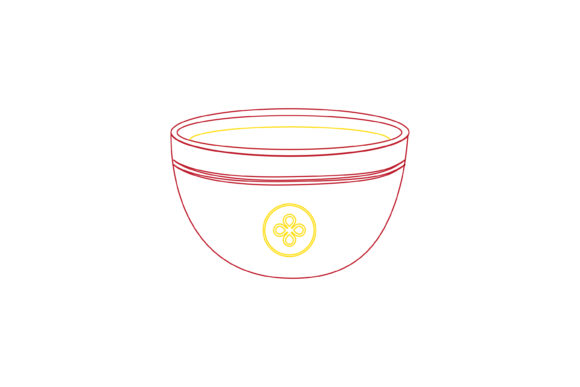
Chinese New Year Handkerchief Color Line
As a designer who’s stitched over 300 custom embroidery projects—from boutique baby onesies to Etsy shop holiday collections—I opened Chinese New Year Handkerchief Color Line expecting charm, but what stood out immediately was its quiet confidence. It doesn’t shout “festive!” with fireworks or dragons—it breathes tradition through subtle linework: delicate blossoms, soft lantern silhouettes, and flowing ribbon motifs that suggest movement without clutter. This isn’t a logo or mascot; it’s a handkerchief-style emblem—balanced, centered, and built for intimacy. Think of it as the kind of design you’d embroider onto a linen tea towel for a Lunar New Year kitchen gift, or stitch in gold thread on the corner of a silk-lined apron for a small-batch artisan food brand.
I tested Chinese New Year Handkerchief Color Line by planning a real project: a set of embroidered cotton tote bags for a local gift shop’s holiday pop-up. The shop wanted something elegant—not cartoonish—that would appeal to multigenerational shoppers. I laid the vector file into my digitizing software and scaled it to 3.5 inches wide—the sweet spot for tote bag front panels—and instantly appreciated how cleanly it held detail. No jagged edges, no pixelation, no awkward gaps between elements. Because it’s a vector-based Graphics asset, resizing felt effortless. That matters when you’re prepping files for both 2-inch patches (for kids’ caps) and 5-inch placements (on pillow covers or sweatshirt backs).
The mood is warm, refined, and quietly celebratory—ideal for handmade products where subtlety signals care. It leans into the elegance of red-and-gold symbolism without leaning on cliché. There are no bold slogans or Chinese characters to misinterpret; instead, rhythm and spacing do the work. That makes Chinese New Year Handkerchief Color Line unusually versatile across categories: a perfect fit for baby embroidery (think onesie corners or bibs), holiday embroidery (kitchen towels, napkin sets), and even wedding gifts (monogrammed handkerchiefs for bridesmaids). As an Icons-category asset, it works best as a focal motif—not background filler—so I’d avoid scattering it across large fabric repeats unless edited intentionally.
In real embroidery use, clarity holds up well—but with caveats. On dense fabrics like twill or fleece, the finer lines (especially the ribbon curls and petal outlines) benefit from a light stabilizer backing and slightly reduced stitch density in satin-stitch zones. On thin or stretchy fabrics—like jersey baby bodysuits or lightweight linen—test first. I ran a sample on 100% cotton poplin with tear-away stabilizer and got clean results, but on a ribbed knit sweatshirt, I’d simplify one or two inner loops manually before stitching. Curved surfaces (caps, mugs, curved pillow seams) demand careful hooping alignment; this design’s symmetry helps, but don’t place it too close to seam allowances or deep curves without mocking up the drape first.
Where Chinese New Year Handkerchief Color Line truly elevates a finished product is in perceived value. Stitched in matte rayon thread on oat-colored canvas, it reads as heirloom-quality—not mass-printed. Customers notice that. For Etsy sellers and craft fair vendors, that translates directly to trust: a buyer holding a tea towel with this motif embroidered in balanced fill and running stitches feels they’re receiving intentional craftsmanship, not a quick digital download. It supports brand consistency too—if your shop uses minimalist East Asian-inspired motifs across stationery, packaging, and apparel, this fits seamlessly as a signature touch.
That said, don’t assume it’s “plug-and-play” for every application. Tiny lettering? There isn’t any—so no legibility concerns. But fine linework near corners or borders can vanish if hooped too tightly or stitched with low thread tension. On dark fabric, test contrast: some reds in the color line may need richer thread tones (like burgundy or crimson) to retain warmth. And for products facing frequent washing—baby items, kitchen towels, aprons—confirm your thread and stabilizer combo holds up after three cold-water cycles. I’d avoid placing it in high-friction zones (like tote bag handles or pocket flaps) unless reinforcing with zigzag-edged applique.
Here’s what I always do before committing Chinese New Year Handkerchief Color Line to a client project or shop listing:
- Test on scrap fabric—same weight, weave, and stretch as your final piece.
- Check thread color contrast in natural light, not just screen preview.
- Review stitch density in satin and fill areas—dense zones can pucker lightweight fabrics.
- Confirm hoop size compatibility—this design scales well, but very small versions (<2”) may lose definition in tight corners.
- Inspect small details at 200% zoom in your embroidery software—look for stray nodes or overlapping paths.
- Mock it in black and white to verify silhouette strength, especially for monochrome branding.
- Compare light and dark backgrounds—some elements read better on cream than charcoal.
- Use proper stabilizer: cutaway for knits, tear-away for stable wovens, mesh for sheer fabrics.
- Verify licensing before selling finished items or bundling as part of a digital embroidery file pack.
For small business owners and makers, Chinese New Year Handkerchief Color Line isn’t just another holiday graphic—it’s a thoughtful design asset that earns its place on personalized gifts, boutique merchandise, and commercial embroidery projects because it respects both the craft and the customer. It doesn’t try to be everything. It does one thing beautifully: distill celebration into quiet, stitchable grace. Use it where attention matters—in the corner of a handmade pillow cover, the hem of a silk scarf, or the inside flap of a custom gift box. That’s where this design doesn’t just sit. It settles in—and stays remembered.