Hand Drawn Coquette Cocktails with Bows
A Designer’s First Glance: Whimsy, Warmth, and Wearability
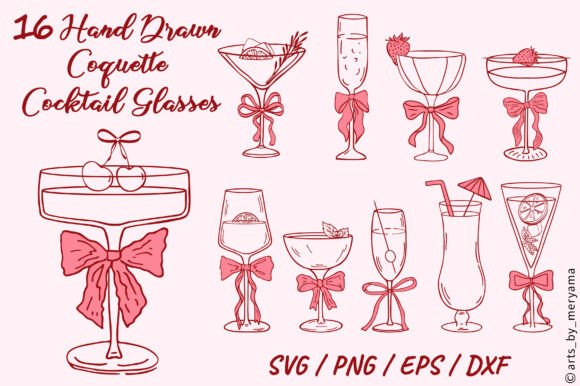
When Hand Drawn Coquette Cocktails with Bows landed in my inbox, I paused mid-coffee—fitting, given the theme. It’s instantly charming: soft ink-like linework, playful bows tied like ribbons around martini glasses and citrus slices, and that unmistakable coquette charm—flirty but friendly, vintage-inspired but fresh. As an embroidery designer who’s stitched everything from baby onesies to boutique aprons, I immediately saw its potential—not as a generic clipart filler, but as a cohesive, personality-driven machine embroidery design that could anchor a whole product line.
Real-World Test: Stitching It on a Linen Tea Towel for a Local Café Pop-Up
Last month, I used Hand Drawn Coquette Cocktails with Bows to embroider a set of linen tea towels for a neighborhood café’s summer launch. We chose the “Lemon Drop” motif—curved glass, twist of peel, bow at the stem—and stitched it centered on the lower corner. The result? A handmade product that felt intentional, not algorithmic. Customers kept asking, “Is that hand-drawn?” (It is—in spirit, even if digitized.) That’s the mark of strong Illustrations: they carry human rhythm through the needle. The curves held up beautifully in satin stitch, and the bows translated into clean, rounded fill areas—not too dense, not too sparse. No thread nesting. No skipped stitches. Just quiet confidence in the vector construction.
Where This Design Shines (and Where It Asks for Thought)
Hand Drawn Coquette Cocktails with Bows thrives on medium-to-heavyweight fabrics where detail reads clearly: canvas tote bags, cotton sweatshirts, structured aprons, pillow covers, and baby swaddles. Its gentle scale—neither oversized nor micro-fine—makes it ideal for custom apparel without overwhelming the garment. On a curved surface like a dad cap? I’d choose the simpler motifs (like the “Champagne Flute” or “Berry Spritz”) and avoid the most intricate bow variations unless using a multi-hoop setup.
That said, proceed carefully on stretchy knits or ultra-thin voile. The design’s delicate lines and layered bow elements rely on stable fabric movement—so a tear-away + cutaway stabilizer combo is non-negotiable for commercial embroidery. And while the 5000 px resolution and 300 DPI give you breathing room for resizing, don’t push it below ~3.5 inches wide in final hoop size—tiny lettering isn’t part of this set, but fine bow loops and stem details *will* blur or stitch poorly if shrunk too far.
What It Adds to Your Finished Product—Beyond Aesthetics
This isn’t just decoration. Hand Drawn Coquette Cocktails with Bows elevates perceived value. A plain cotton kitchen towel becomes a curated gift. A basic black sweatshirt gains narrative warmth. For Etsy sellers and small shop owners, that translates directly to higher conversion—it’s the kind of digital embroidery file that earns “Where did you get that?!” comments. Visually, it supports brand consistency for lifestyle brands leaning into joyful femininity, retro-modern aesthetics, or artisanal hospitality. And because the mood is upbeat but not cutesy, it avoids aging quickly—making it a smart long-term addition to your design assets.
Practical Notes Every Embroidery Designer Should Check
- Test first—on scrap fabric matching your final substrate, using your actual thread colors and stabilizer stack.
- Review stitch density—especially in bow centers and cocktail garnishes. High-density fills can stiffen lightweight fabrics; consider lightening fill angles or reducing density by 5–10% for baby items or holiday embroidery.
- Confirm hoop size compatibility—the SVG and DXF files offer flexibility, but verify your machine’s max hoop dimensions before auto-digitizing.
- Inspect small details—zoom in on PNG previews to spot any unintended gaps or overlapping paths that might cause jump stitches.
- Mock it in black and white—this design relies on shape and flow more than color contrast, so ensure legibility on dark fabric before stitching.
- Use proper stabilizer—for textured fabrics like terry cloth or bouclé, add a topping to prevent thread sinking.
- Verify licensing—the product description confirms commercial use for finished goods, but double-check terms before reselling the embroidery file itself or bundling it into a digital product.
Fabric & Context Pairings That Work Well
For personalized gifts, pair the “Strawberry Daiquiri” motif with ivory baby onesies—it reads sweet but sophisticated. For craft fair products, stitch the “Mojito” version onto navy denim patches and sell them as iron-ons. On a cream-colored linen tote? The “French 75” design adds instant boutique polish. And for holiday embroidery, try the “Cranberry Sparkler” on burgundy tea towels—it’s festive without being literal.
A Final Thought for Creative Entrepreneurs
Hand Drawn Coquette Cocktails with Bows doesn’t shout. It invites. That’s rare in today’s oversaturated Graphics market. As a designer who’s evaluated hundreds of embroidery files, I appreciate how thoughtfully balanced it is: detailed enough to feel special, simple enough to stitch reliably, and stylistically distinct enough to become a signature element for your craft business. It won’t replace technical precision—but it reminds us why people buy handmade: for feeling, not just function. Use it with intention, test it with care, and let its coquette charm do the rest.